TYSONS OFFICE
How to Become a Scholarship Granting Organization (SGO): A Step-by-Step Guide
Jennifer Kim Nguyen
October 23, 2026

The new Education Freedom Tax Credit (aka Federal Scholarship Tax Credit) has opened the largest expansion of school choice in history. Learning how to form a Scholarship Granting Organization (SGO) is one way you can be involved and help others.
More than 30 states have already opted in to the program, with others signaling they’ll follow. Even if yours hasn’t, now is the time to prepare. Keep reading to learn how to form an SGO.
What a Scholarship Granting Organization Is and How You Can Start One

An SGO is a nonprofit that turns donations into scholarships for K-12 students. Under the Education Freedom Tax Credit, donors who give to a qualifying SGO can earn a dollar-for-dollar federal credit of up to $1,700 ($3,400 for married couples filing jointly if each spouse donates). The SGO then awards that money as scholarships to eligible primary and secondary students. Learn more by reading What is an SGO.
The appeal of starting an SGO is that you can decide where the support goes by customizing a mission and parameters that are in compliance with federal requirements. Whether you’re passionate about classical education, faith-based schools, small private schools, math enrichment, or families in an underserved corner of your community, you can build an organization that will provide valuable scholarships for families who wouldn’t otherwise have access to such educational resources.
I’ve experienced first-hand how limited finances and an uneven playing field can narrow — and even close off — a child’s access to educational resources.
How I Became Interested in Scholarships for Education
Long before I started my legal career, I worked for Kumon and saw the magic of what focused tutoring and after-school enrichment can do for a child. It’s very effective, but it’s also expensive. As a result, only a small subset of the population has access to it.
In later years, this became personal in a different way. I had come to the conclusion that a private school was best for one of my children, but when it came time to apply, I realized our family couldn’t afford it. A school scholarship and a gift from family members opened that door for us, but I couldn’t help but wonder if there were other options available. What if there were organizations whose whole purpose was to fill that gap for families like mine? That is exactly what an SGO can do.
That realization is what makes this new opportunity so exciting to me, and it’s why I’ve spent time thinking through exactly what I’d do if I built an SGO myself.
How to Become a Scholarship Granting Organization: What I Would Do
If I were to form an SGO, I’d target my own community first. My city has only about 50,000 people, but most of them have federal tax liability that a $1,700 credit could offset. That means an enormous amount of untapped giving potential is sitting in one small place. Then, I would define the SGO’s mission and intended student population. Whether it’s for math programs, children of widows, or faith-based resourcing, I would consider the students I want to help, noting that they must themselves reside in a covered state. Most importantly, I would ensure that the foundational federal requirements have been met.
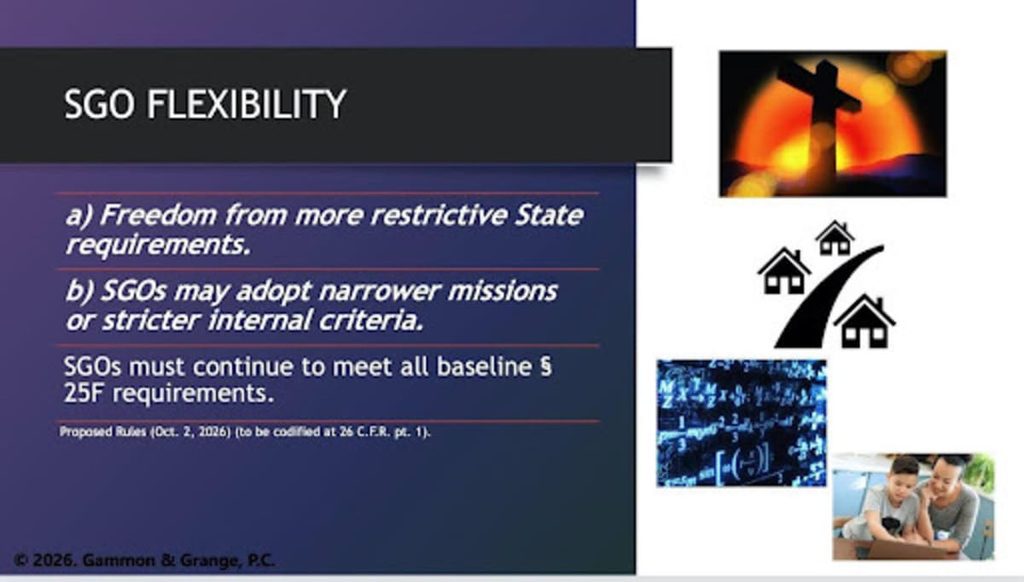
Although my state has not opted into the program yet, I’d take the following steps to prepare:
- I’d build a like-minded team of board members and officers to incorporate as a nonprofit and adopt bylaws. I would want the legal foundation for my SGO to be strong, so I would ensure that all the legal requirements are met and expressly documented in my governing documents for smooth approvals and operations. I would also ensure necessary policies and procedures were in place from the beginning to meet all compliance obligations.
- I’d apply for federal tax-exempt status, obtain an EIN, and set up a § 25F segregated bank account. An SGO has to be a tax-exempt public charity, so I’d apply to the IRS for a determination and be prepared to comply with tax-exempt law. An EIN would need to be set up and a separate bank account established for donors to deposit donations into to prevent commingling.
- Then, I’d get on my state’s SGO list. You must demonstrate that the SGO meets all legal requirements to be included on the list it submits to the IRS. Only donations to SGOs listed on the State List can generate the credit.
- Next, I’d set up scholarship administration around the 90% income test. An SGO must spend at least 90% of its income on scholarships for eligible students. Under the proposed regulations published October 2, 2026, “income” means the organization’s total gross receipts from all sources, measured on the cash method and not reduced by expenses. The money doesn’t have to go out the door in the year it arrives; it must be spent on scholarships by the last day of the taxable year after the year it was received. That leaves no more than 10% for everything else, and it goes fast: credit card and processing fees, state filing fees, and audit costs all come out of it. So I’d budget for those costs before setting staff pay. The 10% has to cover the ongoing work of verifying household income, awarding scholarships to at least 10 students who don’t all attend the same school, and keeping up with audits, reporting, and donor acknowledgments. An existing nonprofit with a broader mission has one option: if at least 85% of its activities are scholarship-granting, it may apply the 90% test only to its §25F segregated account instead of its total income. An organization below that threshold will usually need to form a separate SGO. An SGO operating in more than one state needs a separate segregated account for each state, and its donors can choose which state their gift supports.
- Finally, I’d register with the IRS and build the donor number process as soon as the IRS SGO portal becomes available (likely by early 2028). The temporary regulations require the SGO to assign a unique donor number to each donor who makes a qualified contribution; to give each donor, by January 31 of the following year, a written acknowledgment that includes that number; and to report each donor number to the IRS by February 28, with the donor’s name, address, and total qualified contributions. The donor number matters to donors: they report it on Form 8525 when they claim the credit, and if it is missing, the IRS presumes no qualified contribution was made.
Since incorporating and securing tax-exempt status take time, and states are opting in fast, doing this groundwork now positions you to get on your state’s list as soon as it’s ready, instead of starting from scratch once the program goes live.
The final order of businesses, of course, is waiting for donations to come in. But I think that can be the easy part.
Why Donors Will Donate: Tax Deduction vs. Tax Credit

The Education Freedom Tax Credit makes donating to an SGO especially attractive because you are basically reimbursed for your donation through a taxpayer-friendly tax credit. That is much different than a charitable deduction, which only reduces your taxable income. For instance, with the Education Freedom Tax Credit, a $1,700 donation to a qualifying SGO (or $3,400 if each spouse donates) can offset your tax liability. And if your qualified donation is larger than your tax liability in a given year, the unused portion can carry forward as a credit for up to five years.
This can make a donor’s giving very tax-friendly and can make fundraising for your SGO far more appealing.
Frequently Asked Questions
How do you become a scholarship granting organization?
At a high level: incorporate as a nonprofit and adopt federal SGO-compliant bylaws, apply for federal tax-exempt status as a public charity, get on a state’s approved SGO list once your state has opted in, and set up scholarship administration and safeguards that meet the program’s rules on spending, student eligibility, independence, reporting, and fraud prevention. Bring in professional help, especially on the legal and accounting ends.
Do scholarships from SGOs only benefit private school students?
No. SGO scholarships can cover a broad range of public and private K–12 education expenses, including school supplies, tutoring, bus transportation, curriculum and materials, dual enrollment courses, and educational therapies. That means homeschooling families and students in various settings may be able to benefit too. The specifics of what qualifies are still being finalized in the program’s rules, but the intent is broad. You can read more about how the credit and its scholarships work in my post on the new federal SGO tax credit and Is There a Homeschool Tax Credit.
Who can start an SGO?
Just about anyone with a passion for education and strong administrative abilities can start an SGO. You don’t need to be an educator or financier by trade. You will need a clear mission and a willingness to handle (or get help with) the compliance side to administer scholarships with a team that is prepared to do so correctly.
It is important to note that an SGO may not award scholarships to “disqualified persons.” That proposed definition covers: officers, directors, and trustees; anyone involved in selecting recipients; substantial contributors (more than $5,000, if that exceeds 2% of contributions); and family members of each, including siblings. These scholarships must truly provide only public benefit, not private.
Can I pay myself for running an SGO?
Yes, possibly, within limits. The program requires at least 90% of an SGO’s funds to go toward scholarships, so the remainder can cover administrative costs, which can include reasonable compensation for the hours of service put into running the organization.
Do I have to wait for my state to opt in?
You can prepare now, even if your state hasn’t finalized its participation. Incorporating, adopting bylaws, and securing tax-exempt status all take time. And if you’re thinking about how to encourage your state to opt in, read 2027 Federal Scholarship Tax Credit: How to Help Your State Opt In.
Why is the tax credit better than a charitable deduction?
A deduction only reduces your taxable income, while this SGO tax credit reduces your tax bill dollar for dollar — up to $1,700 (or $3,400 for married couples filing jointly). If employer withholdings exceed your tax liability, a refund or reduced withholdings may be possible. If your qualified donation exceeds your tax liability, the unused credit carries forward for up to five years. Feel free to contact me for customized tax planning advice and options.
Should I start my own SGO or support an existing one?
It depends on your goals. Starting your own gives you the most control over your mission but comes with formation and ongoing compliance work. Supporting or partnering with an existing SGO is simpler. It’s worth discussing both options and considering the costs and benefits with a nonprofit attorney.
How I Can Help
I hope you can see that I’m passionate about the opportunities the Education Freedom Tax Credit is creating. Not only am I involved in many conversations with current and retired educators, nonprofit visionaries, school leaders, taxpayers, and parents about it, but I also just presented a tax law workshop focused on these opportunities at the 2026 Christian Legal Society National Conference.
If you’re considering starting an SGO or weighing out the benefits of joining an existing one, I’d love to talk. Reach out to me, Jennifer Kim Nguyen, at Gammon & Grange.
This post provides general information about a developing area of tax law and is for informational purposes only. Program rules are still being finalized, and state participation and figures change. This is not legal or tax advice and does not create an attorney-client relationship. Please consult a qualified professional about your specific circumstances.
Share this Article:



Get A Free Consultation
Get a Consultation With a Nationally Recognized Nonprofit And Small Business Lawyer Today.