TYSONS OFFICE

Innocent Spouse Relief: What Is It and What Are the Four Types?
Jennifer Kim Nguyen
May 22, 2026

Life doesn’t always go according to plan, and few surprises are more unsettling than an IRS bill arriving in your name or wage garnishments for taxes based on decisions you did not make.
If you signed a joint tax return in good faith and are now facing collection activity for your spouse’s unreported income, questionable deductions, or unpaid taxes, you may have more options than you think. “Innocent spouse relief” reflects the IRS’s understanding that joint filing can produce genuinely unfair outcomes and that spouses who had no knowledge of or control over the problem shouldn’t automatically bear the consequences.
Keep reading to learn more about the program and the four types of relief available.
An Explanation of Innocent Spouse Relief
When a married couple files a joint federal income tax return, both spouses become “jointly and severally liable” for the full amount of tax owed on that return. This means the IRS may collect the entire debt from either spouse, regardless of who earned the income or who made the errors.
What most people do not realize is that this liability does not automatically end when a marriage does. Even after a divorce, a former spouse can be pursued for unpaid taxes from a joint return, even if a divorce decree assigns that tax obligation to the other party.
Innocent spouse relief is a set of IRS programs designed to address the difficulties that may result when one spouse has little knowledge of or control over the couple’s tax filings. In such scenarios, it would be unjust to hold that spouse responsible for tax problems driven entirely by the other’s actions. That is why, under Internal Revenue Code 6015 and related provisions, qualifying taxpayers can be relieved of some or all of the tax, interest, and penalties from a joint return.
Not every spouse qualifies for the same type of relief, which is why the IRS created four distinct programs, each designed for a different set of circumstances.
The Four Types of Innocent Spouse Relief
The four types of innocent spouse relief share a common purpose but apply to different situations related to current marital status, what you knew when you signed the return, and whether the issue involves an understatement of tax, an underpayment, or something else entirely.
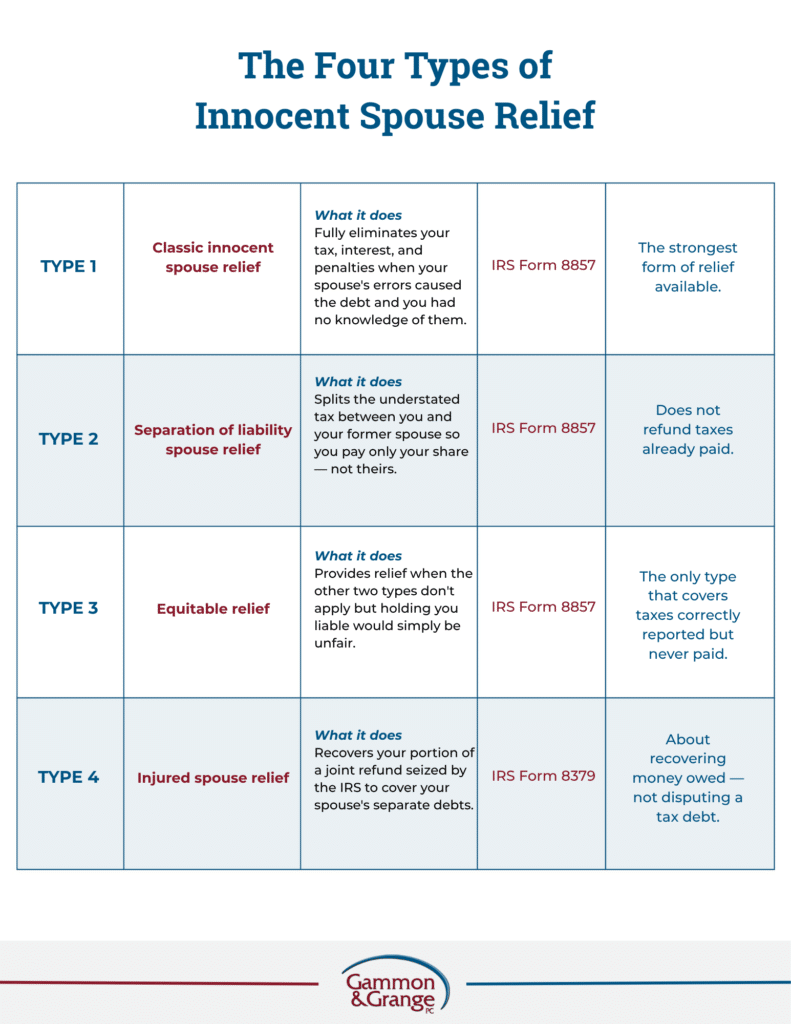
1. Classic Innocent Spouse Relief
Classic innocent spouse relief is the foundational form of protection the IRS offers. If your spouse underreported income, claimed deductions they had no right to, or misrepresented credits on a return you both signed, and you had no reason to suspect any of it at the time, classic innocent spouse relief may fully remove your liability for the resulting tax debt.
This is the IRS’s most direct form of protection for a spouse who was genuinely in the dark. If granted, classic innocent spouse relief eliminates not just the tax but any accumulated interest and penalties alongside it.
2. Separation of Liability Relief
If your marriage has ended and you are now being pursued for a joint tax debt, separation of liability relief offers a different kind of protection than the classic form. Instead of removing your liability entirely, separation of liability draws a line between what is yours and what is your former spouse’s. The understated tax then gets divided based on each person’s contribution to the problem, and you become responsible only for your allocated share.
There is one important limitation to take note of: this relief does not generate a refund for taxes already paid. It only protects you from being required to pay your former spouse’s allocated share going forward. Relief may also be denied if either spouse transferred assets between themselves to avoid taxes, or if you had actual knowledge of the errors.
3. Equitable Relief
Equitable relief is a catch-all provision for taxpayers who do not meet the strict criteria for either of the first two types but can demonstrate that it would be unfair to hold them liable. It is also the only type that can cover taxes that were reported correctly but never paid, which opens the door for people whose situations involve something other than a spouse’s hidden income or false deductions. It can also apply in community property states, where income is treated as shared regardless of who earned it.
When evaluating an equitable relief claim, the IRS considers a range of factors holistically. These include your current marital status, whether you would suffer economic hardship if held liable, whether you knew or had reason to know about the unpaid tax or understatement, whether you were a victim of domestic abuse or were subject to financial control by your spouse, whether you received any financial benefit from the unpaid taxes, and your general history of tax compliance. No single factor is determinative.
Equitable relief is the most nuanced of the four types, and pursuing it requires telling an honest story in full. It tends to be especially important for people who were in relationships where one spouse controlled the finances entirely or where abuse made it impossible to question what was being filed.
4. Injured Spouse Relief
While the other three types of relief deal with tax debts you shouldn’t owe, injured spouse relief deals with a refund you shouldn’t have lost. It applies when the IRS intercepts a joint refund to cover your spouse’s separate debts — past-due child support, unpaid student loans, state taxes, or other obligations that are entirely your spouse’s responsibility — and takes money that was rightfully yours in the process.
Once you understand the types of programs available, you can begin pursuing the relief you need.
How To Request Innocent Spouse Relief

If you are pursuing classic innocent spouse relief, separation of liability relief, or equitable relief, you must fill out IRS Form 8857 (Request for Innocent Spouse Relief). It is important to note that you do not need to specify which type of relief you are seeking. The IRS will review your circumstances and determine which type — or combination of types — applies to your situation. It’s also important to note that filing Form 8857 will trigger a notification to your current or former spouse.
Injured spouse relief is handled separately through IRS Form 8379 (Injured Spouse Allocation) and can be filed along with your return or after you discover that your refund has already been offset.
There are deadlines to keep in mind with either form to preserve your rights. Given the complexity of these cases and the financial stakes involved, it’s wise to consider working with a tax attorney before submitting any forms.
FAQs
Is there a time limit for innocent spouse relief?
Yes, though the rules vary depending on which type of relief you are seeking. For classic innocent spouse relief and separation of liability relief, you generally must file within two years of the date the IRS first attempted to collect the tax from you. Equitable relief has more flexible timing, and, in some circumstances, claims can be filed beyond that two-year window.
Injured spouse relief has its own deadlines tied to the tax year in question. Because missing a deadline can eliminate your options entirely, it is worth consulting with a tax attorney as soon as you become aware of the problem rather than waiting to see how the situation develops.
Can the IRS take my house if my husband owes back taxes?
If you filed a joint return with your spouse, the IRS can potentially place a lien on jointly owned property — including your home — to satisfy the tax debt. Whether and how quickly that happens depends on the amount owed, how far along the collection process is, and whether any relief claims are pending. Filing for innocent spouse relief can pause collection activity against you while your claim is being reviewed.
Am I responsible for my spouse’s tax debt before we were married?
Generally, no. Innocent spouse relief and joint and several liability apply only to joint returns you filed together. Tax debts your spouse incurred before your marriage, or on returns filed as a single taxpayer, are not your responsibility simply because you later married that person.
Final Thoughts
Facing IRS collection activity is stressful under any circumstances, but it is especially difficult when the debt you are being asked to pay does not feel like it belongs to you. If you signed a joint return in good faith and are now dealing with the consequences of your spouse’s financial decisions, please know that you are not without options. The four types of innocent spouse relief exist precisely because the tax law recognizes that fairness has to account for what you actually knew, what you actually controlled, and what you actually did.
As a tax attorney, I have helped taxpayers navigate these situations, and I understand that they involve far more than just tax law. Issues like these involve real lives, difficult histories, and a great deal of uncertainty. If you would like to talk about your situation, I invite you to schedule a consultation. I’d be honored to help.
This article is intended for general informational purposes only and does not constitute legal advice. No attorney-client relationship is formed by reading this post. Tax situations vary significantly; please consult a qualified tax attorney regarding your specific circumstances.
Share this Article:



Get A Free Consultation
Get a Consultation With a Nationally Recognized Nonprofit And Small Business Lawyer Today.